
Parole vs Probation in San Miguel County
San Miguel County parole and probation both describe supervision after a criminal case, but they come from different systems. Parole follows a Colorado Department of Corrections prison sentence. It is tied to CDOC custody, parole eligibility, mandatory release, and the Colorado State Board of Parole. Probation is a court sentence or court-ordered supervision term. In San Miguel County, probation is part of the Colorado Judicial Branch's 7th Judicial District Probation Department, not CDOC prison release.
That split matters when a released San Miguel County inmate is no longer on the current jail list. A bond release from the San Miguel County Jail may lead back to court with no supervision yet. A county sentence may end with no parole. A prison sentence may move the public trail to CDOC and the Parole Board. A probation sentence may be documented in the San Miguel County court record and monitored through the local probation office in Telluride.
| Supervision Type | Who Handles It | Best San Miguel County Check |
|---|---|---|
| Parole | CDOC Adult Parole and the Colorado State Board of Parole | CDOC Offender Search, the Board calendar, and CDOC parole channels |
| Probation | Colorado Judicial Branch, 7th Judicial District Probation Department | San Miguel County Probation and court records |
| No supervision | Release by bond, dismissal, time served, or sentence discharge | Jail release record, court disposition, or the full release path on San Miguel County released inmates |
- Parole
- Supervision after release from a state prison sentence, under CDOC parole authority and Board rules.
- Probation
- A court-ordered sentence or supervision term that may occur without a prison commitment.
- Discharge
- The end of custody or supervision for the relevant case or sentence, subject to the official record.
- Absconder
- A person who has stopped reporting or cannot be located by the supervising authority.
Verify San Miguel County Supervision
The best San Miguel County parole and probation check starts with the sentence path. If the person served a CDOC prison sentence, search CDOC first. If the person was sentenced in county or district court to probation, use the San Miguel County court record and the local probation office. If the person only bonded out or had charges dismissed, neither parole nor probation may apply.
- Decide whether the case was a jail release, a probation sentence, or a CDOC prison case. The jail roster alone cannot make that distinction after release.
- Search CDOC Offender Search by DOCNO when available, or by name and gender when the number is unknown.
- Use the CDOC Parole Board calendar when the question involves a parole hearing date or parole-release review.
- Check Colorado Judicial Branch dockets and San Miguel County court records for probation orders, revocation hearings, warrant recalls, and termination orders.
- Contact the San Miguel County Probation Office for probation supervision questions, using the local office details below.
- Use Colorado VINE for custody-change notice when the person is still in a participating custody feed.
CDOC cautions that the public offender search is a lookup tool, not a certified record. Names can be incomplete or entered under an arrest or prosecuted name. For a formal parole status or date, confirm with CDOC or the Board. For probation, the court order and supervising probation department are the stronger sources because probation is created by the court.
Note: A released person missing from the San Miguel County Jail current list may be discharged, transferred, on probation, on parole, or simply outside the current PDF cycle.
San Miguel County Probation Office
San Miguel County probation is local and specific. The Colorado Judicial Branch lists the San Miguel County Probation Office at the historic courthouse in Telluride, with the office on the second floor. The same probation page notes a practical limit: the San Miguel office is staffed by a single probation officer and may be closed when that officer is in court, in meetings, or in the field. A closed door does not prove that a released person is not on probation.
The Colorado Judicial Branch San Miguel County Probation page gives the local supervision context for released-person checks.
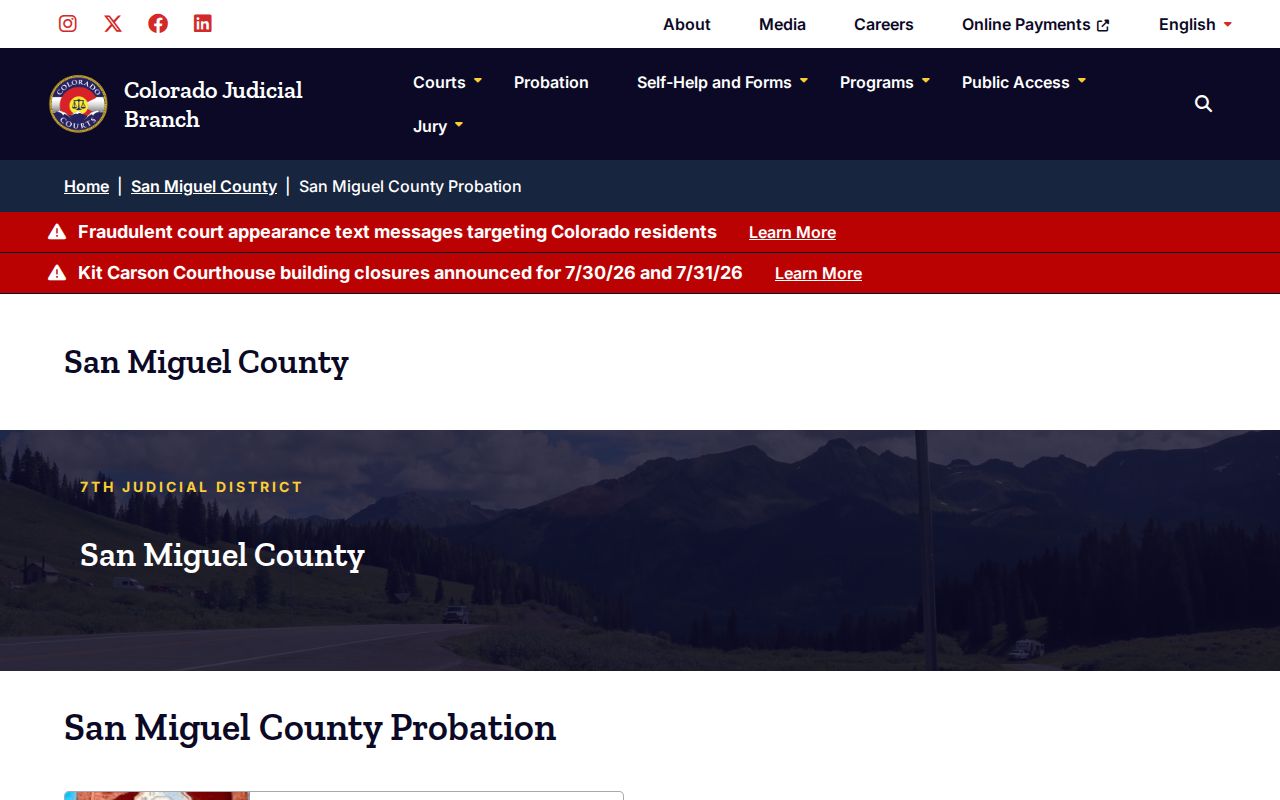
Use this office information with the court record because probation is created by a court order, not by the jail roster.
San Miguel County Probation Office
305 West Colorado Ave., P.O. Box 919
Telluride, CO 81435
Phone: 970-369-3320
Fax: 970-728-6216
Email: pamela.stewart-maddox@judicial.state.co.us
Hours: Monday-Friday, 8:00 a.m.-5:00 p.m.
The district page also identifies Chief Probation Officer Robert Omer for the 7th Judicial District. District administration is separate from the local San Miguel office, but it gives context for how probation is organized across western Colorado counties. The same district materials report adult and juvenile caseload figures, successful termination figures, and drug-court expansion into San Miguel County. Those details show that San Miguel probation is part of a broader district system even when the Telluride office is the local contact point.
San Miguel County Reentry Support
WAGEES lists Grand Junction area coverage for San Miguel County and nearby Western Slope counties. WAGEES is a community partner network for people returning from prison, but its role is not the same as parole authority. The listing states that community partners cannot authorize changes to a parole plan or parole jurisdiction. Only the Division of Adult Parole can do that.
For a released San Miguel County person, this creates a clean division. A reentry partner may help connect a parolee with services, while CDOC Adult Parole controls the parole plan and jurisdiction. Probation remains separate again, because local probation terms come from the court. If a person says they moved, changed reporting location, or switched supervision counties, confirm the change with the supervising agency rather than with a community provider.
San Miguel County Violations
Supervision conditions are the rules a person must follow after release or sentencing. Parole conditions may include reporting to parole, staying within the approved parole plan, following treatment or program directions, and avoiding new violations. Probation conditions come from the sentencing court and can include reporting, treatment, community service, restitution or costs, testing, or other case-specific terms. The public record usually does not show every day-to-day condition, but it can show hearings, warrants, revocations, and termination orders.
No San Miguel County-specific public absconder list was found in the official county sources reviewed. Do not infer an absconder or warrant status from absence on the jail list. A person may be off the current list because they were released, moved to court, transported, transferred, or booked under a name variation. Parole warrant status should be verified through CDOC and parole channels. Probation warrant or revocation status should be checked through court records and the probation office.
Colorado VINE can help while a person is still in a custody feed, because it sends custody-change notifications for participating systems. It is not a permanent parole or probation history. If a released person is arrested on a violation and booked into San Miguel County Jail, the Activity Logs and custody phone line may become relevant again. If the violation is handled by CDOC or a court without local jail custody, the state or court record may be the better path.
Records After San Miguel Release
The San Miguel County Criminal Justice Records Request Form lets a requester seek reports, arrest records listed as official action, and photos when legally releasable. The form requires requester information, a statement for pecuniary gain under C.R.S. 24-72-305.5, and state-issued identification. That route is better than trying to reconstruct supervision or release facts from an old roster.
The Sheriff's records unit handles criminal justice records held by the Sheriff's Office, including inmate information and media. Questions go to 970-728-4442 or records@sanmiguelsheriff.org. The form lists a research fee of $33.38 per hour, with the first hour free; no charge for electronic release; $5 for the first 15 physical pages; $0.25 per page after that; and $20 for a flash drive. Fees over $30 are due in advance.
How San Miguel County Supervision Ends
Supervision ends through discharge, termination, revocation, or a new legal event. For parole, CDOC and the Colorado State Board of Parole control the parole trail. Colorado parole rules define mandatory release date, parole eligibility date, release, rescission hearing, and revocation hearing. A parole grant is not final until the person physically leaves the facility on the effective date. A release date can be suspended or reconsidered before release for good cause.
For probation, the court record is central. A San Miguel County court file may show sentencing, probation terms, a revocation case, a warrant recall, or successful termination. The 7th Judicial District probation materials report district-level successful termination figures, but a single person's status still requires the person's own court and probation record. If supervision has ended, the release or discharge fact may be part of a record of official action under Colorado criminal-justice records law, subject to limits, redactions, and sealing.
When the question is broader than supervision, use the main San Miguel County released inmates path. That route combines the Sheriff's Activity Logs, current custody phone line, records request, CDOC search, court docket, VINE, and federal or ICE sources where needed. Parole and probation are only two of several possible outcomes after someone leaves the San Miguel County Jail.
Keep the agency lanes separate. The San Miguel County Probation Office can address local probation supervision, but it does not decide CDOC parole. CDOC parole channels can address state-prison release supervision, but they do not replace the San Miguel County court record for a local probation sentence. The Sheriff's records unit can document the jail custody event, but it does not set probation terms or parole conditions.